Sheridan Le Fanu’s novella, Carmilla, has been described as a highly atmospheric novel where the setting (landscape, nature, architecture, shadows, gothic paraphernalia, etc.) is inextricably connected to the theme and characters of the novella.
Sheridan Le Fanu’s gothic novella “Carmilla” follows a story told by a young woman named Laura that occurred when she was nineteen. One day, Laura and her father witness a carriage crash, where a young girl, Carmilla, and her mother emerge. The mother claims she must continue her journey, so Laura’s father offers to keep the girl in his care until her return. But Carmilla is not who she seems, rather she is a vampire who is permanently stuck at 18. Through the novella, the reader is immersed in a highly atmospheric story that adds to the themes of the supernatural, deception, isolation and loneliness, and power and control. As well as how these themes intertwined with one another. Throughout the book, the use of landscapes outside and inside the schloss, candlelight, and lime trees are key in the novella to create an eerie and foreboding atmosphere.
From the start of the book Laura as the narrator makes a point to describe the landscape, precisely where she lives with her father. She calls the location a very lonely place surrounded by forest and a winding road. The castle sits seven English miles away from the nearest village. This shows the physical isolation that Laura deals with, unfortunately, this makes her and her father far more susceptible to those with ulterior motives as their isolation makes them desire connection. This is something that Carmilla takes advantage of. More importantly, she talks about an abandoned village with a church and cemetery three miles from their schloss located between their schloss and their friend General Spielsdorf’s schloss, which is used as a foreshadowing effect for the story. Especially as Laura and the general’s niece were victims of Carmilla.
Being so close to an abandoned village would be unsettling but Laura and her father feel very comfortable and safe in their schloss. The castle itself does not seem all that different from other gothic castles, it has a drawbridge and a moat, which are added as a form of security. In times of turmoil including plagues, war, or even the potential dangers in the night the drawbridge is raised, and the murky waters with the possibility of dangerous creatures ready to attack. A raised drawbridge is a clear statement but for Laura, the drawbridge stays down, “never raised in my time, and its moat, stocked with perch, and sailed over by many swans, and floating on its surface white fleet of water-lilies” (ch 1, pg.4). These descriptions inform the reader of a lot, perch is a carnivorous fish but far from threatening to humans, knowing that it is well stocked with these underwater animals means that the water must be pretty clear to see them moving around. Swans are probably the most dangerous due to their size and pecking ability when provoked but with the moat, they are calm. In terms of symbolism, swans are very feminine and their beautiful white feathers are seen as pure. The water lilies are seen as sweet and innocent, resting calmly on still water. Both the symbolism of the swans and water lilies is similar to Laura as she is so young and naive, unaware of the world’s potential danger. All of these aspects of the moat present the opposite of what is expected from a drawbridge which tells the reader that Laura and her father feel very safe in their home and that any potential dangers are nonexistent. They are unconsciously inviting evil into their home and the easy access to the home is almost serving as a welcome sign, especially for the vampire Carmilla who is taking advantage family’s loneliness and kindness. Through a deceitful carriage crash, she was welcomed into Laura and her father’s home.
Bringing Carmilla into the schloss Laura has her stay in what she considers the most handsome room. The tapestry placed on the wall depicts the Egyptian Queen, Cleopatra having a snake bite her breast as she took her own life. This stately image was placed opposite the foot of the bed, for whoever inhabits the bed would see the image, which may be a source of empowerment for Carmilla. The snake bite is significant because it symbolizes the physical act of a vampiric bite that Laura will receive from Carmilla. This adds to the supernatural nature of the vampire, the tapestry alludes to her not being human and may be more similar to a snake.
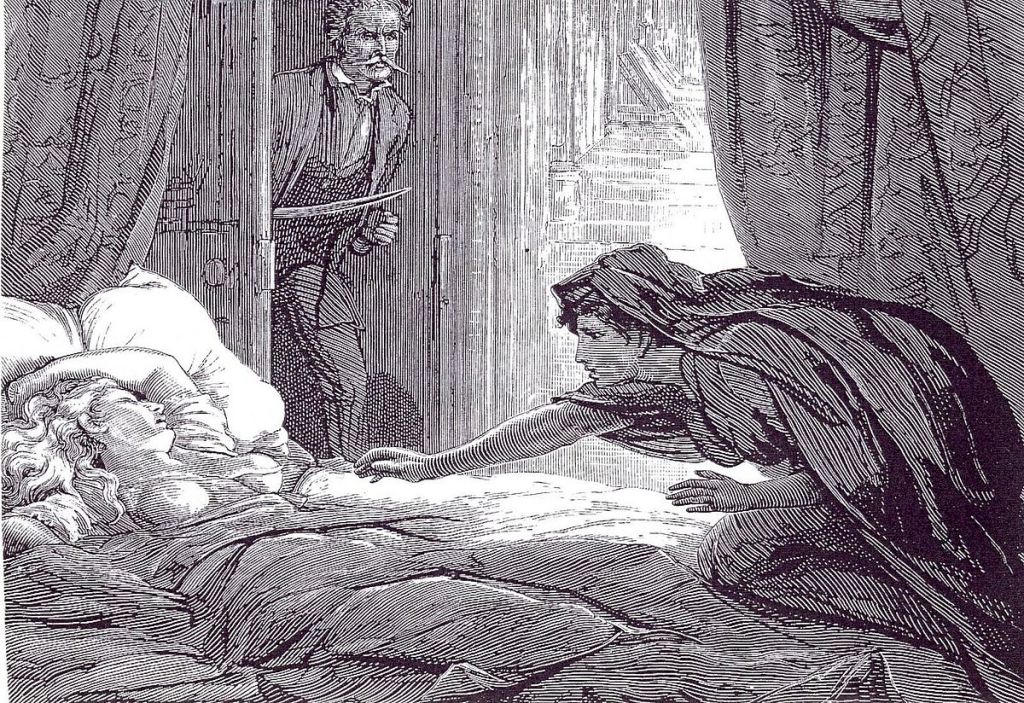
It was further reiterated that Carmilla may not be who she seems when the use of light is added to the novella. The strength of the light is presented as a foreboding sense of evil, especially in the use of light upon Carmilla. It is the lack of light that makes Carmilla such an uneasy character, when she first arrives in her room she is lit by just candles. The dim light on beautiful Carmilla left Laura intrigued but also uneasy suggesting that there is something otherworldly about her. Later in the book the use of light from the candle represents another eerie scene, where Laura wakes up from her sleep in a stage of fear as “the room was lighted by the candle that burnt there all through the night, and I saw a female figure standing at the foot of the bed, a little at the right side. It was in a dark loose dress, and its hair was down and covered its shoulders” (ch 6. pg. 46). Laura felt as if it was a trick by Carmilla which means while the figure’s face was not lit that it had enough of a physical resemblance to her. But it also means that the figure is deliberating trying to obscure their identity. This adds a feeling of unease and fear which is only amplified by the darkness and shadowy quality of the scene. Both scenes show the power that Carmilla has over Laura through both fear and desire for her.
There is another way in which the reader senses that Carmilla is not human. The use of lime trees as a recurring motif in the novella seems to act as a beacon of supernatural energy. At the beginning of the novella, the lime trees seem to be a part of the beauty in the landscape and the schloss. Laura referred to the lime trees as magnificent and sat under them with her father to discuss the pain of loss the General felt about his late niece. We later know the death is due to Carmilla exploiting the General and his niece’s loneliness as well. As the story progresses the lime trees take on a darker and ominous meaning, as it is a focal point of the route right where the carriage crash which is the arrival of Carmilla. This highly suggests that the lime trees are the beacon and safe place for the supernatural. As the novella continues we see the trees act as a vital part of the landscape with the story. Mademoiselle Lafontaine in conversation with Madame Perrodon said that “the long lime tree walk, behind Carmilla’s bedroom window, is haunted!” and that Martin told her “when the old yard gate was being repaired, before sunrise, and twice saw the same female figure walking down the lime tree avenue” (ch 7. pg. 49). This blends both landscapes and light adding an eerie feeling that leaves an unsettling feeling within the characters and readers alike. The use of the phrases to describe the setting evokes a sense of a quiet and isolated location. The repeated unexplained instance also leads to a sense of unease and mystery. As well as supports that the lime trees are far more ominous and a beacon for the supernatural. It could be reasonably believed that Carmilla also finds a sense of power or safety in the lime trees.
Throughout the novella, Sheridan Le Fanu skillfully employs the natural environment, both inside and outside the schloss to create a sense of calm and safety that is easily impenetrable by danger. The candlelight adds to the danger and makes Laura more aware of who has been invited into her home. Finally, the use of the lime tree acts as a beacon of the supernatural but also a source of beauty. The use of these literary elements in Carmilla is effective in creating an eerie and foreboding atmosphere that is gothic literature that keeps both the characters and readers on edge.
Gothic Mysteries in Spring 2023
 Eleanor Grant
Leave a comment